
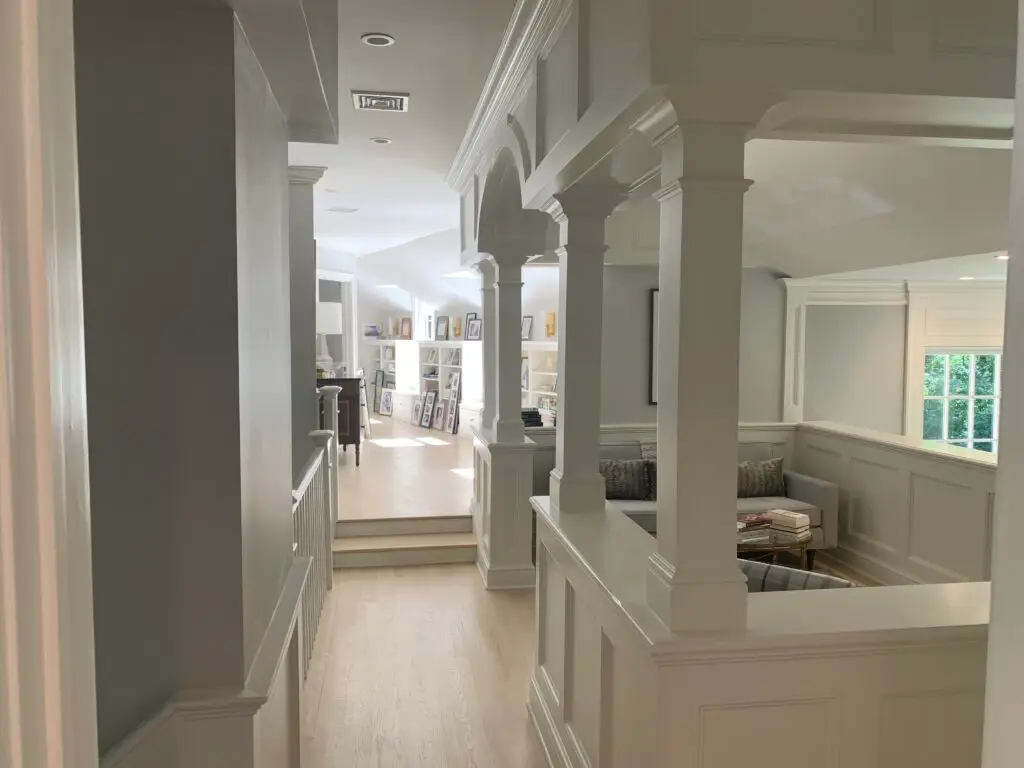
In many American homes—from classic ranch-style houses to modern suburban builds—the hallway is often an architectural afterthought. Without windows to provide natural light, these transitional spaces can feel cramped, gloomy, or “tunnel-like.”
However, at Anderson’s Painting, we know that the right color choice can turn a dark corridor into a bright, welcoming passage. Choosing a color for a windowless hallway isn’t just about picking a shade you like; it’s about understanding light reflection and spatial perception.
Challenges of Windowless Hallways
To solve the problem, we first have to understand the two main obstacles these spaces present:
Lack of Natural Light
Without windows, there is no “color rendering” from the sun. Colors will look different under artificial light (LED or incandescent) than they do in a showroom. A color that looks like a soft “cream” in a sunny living room might look like a muddy “yellow” in a dark hallway.
Narrow or Enclosed Layouts
Hallways are typically the narrowest parts of the home. Without a view to the outside, the walls can feel like they are closing in. Dark or overly saturated colors absorb the limited light available, making the space feel even smaller.
Best Paint Colors for Dark Hallways
The goal is to maximize the Light Reflectance Value (LRV)—a scale from 0 to 100 that measures how much light a color reflects.
Light Neutrals (Warm Whites, Greige)
- Warm Whites: Pure, stark whites can often look “gray” or “dingy” in a dark hallway. Instead, look for whites with a hint of warmth (like Benjamin Moore Simply White or Sherwin-Williams Alabaster). These bounce light while keeping the atmosphere cozy.
- Greige: A blend of gray and beige is a favorite for U.S. homeowners. It provides more character than plain white but remains neutral enough to brighten the area.
Soft Pastels and Muted Tones
If you want color without the “closing-in” effect, consider:
- Pale Blue/Aqua: These colors recede visually, making walls feel further away than they actually are.
- Soft Sage: A very light, muted green can bring a sense of nature into a space that lacks an outdoor view.
Light Gray vs. Beige Comparison
- Light Gray: Gives a crisp, modern feel. However, in windowless spaces, gray can lean “cold” or “industrial” if the artificial lighting isn’t warm enough.
- Beige/Tan: These are inherently warmer. They make a hallway feel inviting, but be careful of “pink” or “yellow” undertones that can become exaggerated under traditional light bulbs.
Colors to Use Carefully
Dark Colors and High-Contrast Tones
While “moody” hallways are a current design trend, they require expert execution. Navy, charcoal, or forest green will make a windowless hallway feel very dark. If you go this route, you must significantly upgrade your lighting to prevent the space from feeling like a cave.
Cool Whites Without Proper Lighting
Avoid “Blue-based” or “Cool” whites in dark halls. Without natural sunlight to balance them out, these colors often take on a clinical, sterile, or even “purplish” hue that feels unwelcoming.
Lighting + Paint Color Strategies
Paint and light work as a team. You cannot fix a dark hallway with paint alone.
Bulb Temperature Recommendations
- 2700K – 3000K (Warm White): Best for beige, tan, and warm wood tones.
- 3500K – 4000K (Neutral/Cool White): Best for making grays look true and whites look crisp. Professionals often recommend 3500K for hallways to mimic daylight as closely as possible.
Using Semi-Gloss or Satin Finishes
The “sheen” of the paint matters as much as the color.
- Satin: The standard for hallways. It has a soft glow that reflects light without being “shiny.”
- Semi-Gloss: Use this on trim, baseboards, and doors. The higher shine creates a visual frame and bounces light back into the center of the hall.
- Avoid Flat/Matte: Flat paint absorbs light. In a dark hallway, you want every bit of reflection you can get.
FAQs
Does white always work in dark hallways?
Not necessarily. As mentioned, if there is zero light to reflect, white can look like a dull, shadowy gray. Sometimes a “mid-tone” neutral works better because it brings its own “pigment power” to the space.
What color makes a hallway look wider?
Cooler tones (light blues, cool grays) are known to “recede” from the eye, which can create the illusion of more width. Painting the ceiling a slightly brighter white than the walls also helps the space feel taller and more open.
Should hallways match adjacent rooms?
They don’t have to match exactly, but they should “flow.” Professionals usually recommend staying within the same color family or using a lighter version of the color found in the main living area to create a cohesive transition.
Transform Your Hallways with Anderson’s Painting
Choosing the right color for a windowless space is a science. At Anderson’s Painting, we don’t just apply paint—we provide expert color consultations to ensure your home feels bright, cohesive, and professionally finished. Whether you want a modern greige or a classic warm white, we bring the tools and the talent to brighten up your home’s most challenging spaces.
Click Here to Schedule Your Free In-Home Estimate and Color Consultation with Anderson’s Painting