
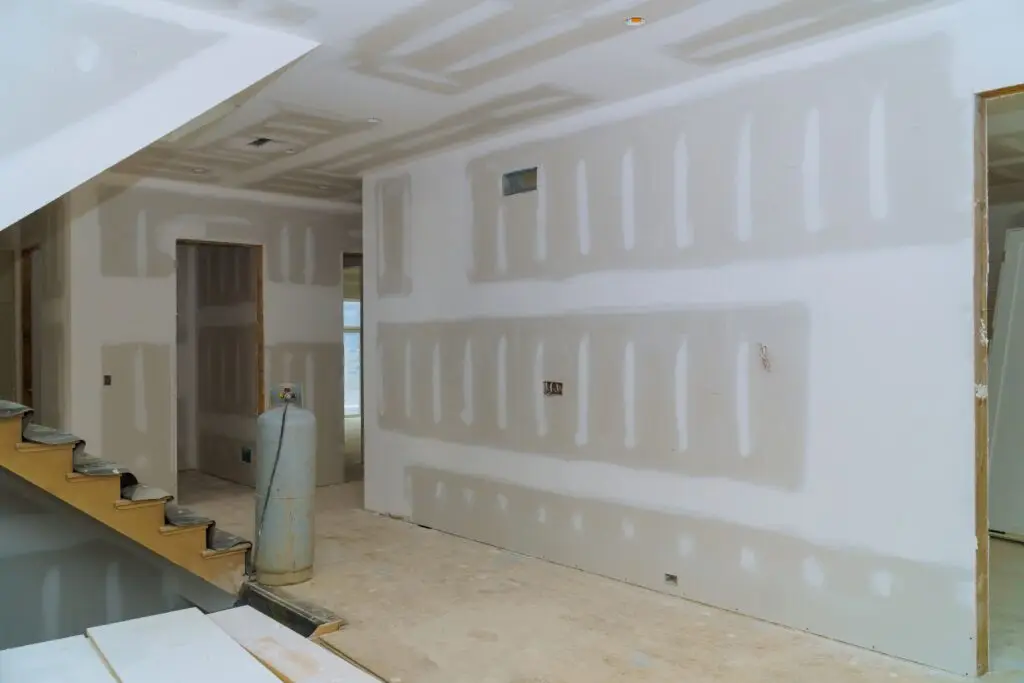
When you look at a wall, you see the paint. But beneath that color is a complex series of mudding and sanding steps known as the “Drywall Finish Levels.” These standards, established by the Gypsum Association (GA), dictate how smooth your walls will be before the first drop of primer ever touches them. At Anderson’s Painting, we understand that paint is a magnifying glass—if your drywall finish isn’t up to the task, even the most expensive paint will look lackluster.
Quick Answer: What Are Drywall Finish Levels?
Drywall finish levels range from Level 0 (unfinished) to Level 5 (the smoothest possible finish). Most standard homes use Level 4, which is suitable for flat or eggshell paints. Level 5 is the “gold standard” reserved for areas with high-gloss paint or extreme lighting where any tiny imperfection would be instantly visible.
The 5 Levels of Drywall Finish
Level 0: Unfinished
This is drywall that has been hung but has no tape, mud, or fasteners covered. It is essentially bare boards.
Level 1: Fire-Rated
Used in areas where air tightness is required but appearance is not (like above drop ceilings or in attics). Tape is embedded in mud, but the fasteners and tape are not covered.
Level 2: Utilitarian
Typically used in garages, sheds, or behind ceramic tile. It receives one coat of mud over the tape and fasteners, but it is not sanded or smoothed.
Level 3: Textured
Used for surfaces that will be covered by heavy textures (like thick knockdown or popcorn). It requires two coats of compound, making it smoother than Level 2 but not ready for paint.
Level 4: The Standard
The industry standard for most residential walls. The tape and fasteners receive at least three coats of compound and are sanded smooth. This level is perfect for flat or eggshell paints in average lighting conditions.
Level 5: The “Showroom” Finish
This is the ultimate smooth finish. The entire surface of the drywall is covered with a thin “skim coat” of joint compound, ensuring the paper of the drywall and the mud joints have the exact same texture.
Why Level 5 Is a Game Changer
Level 5 is not just “one more coat of mud.” It is a structural commitment to consistency.
- Glossy Paint Needs It: If you use semi-gloss or high-gloss paint, those finishes will highlight the slight texture difference between the drywall paper and the mudded joints. A Level 5 finish ensures the sheen is perfectly uniform.
- Strong Lighting: In rooms with large windows or “wall-washing” lights (lights that run parallel to the wall), even a tiny ripple in a Level 4 finish will cast a shadow. Level 5 eliminates those shadows by creating a perfectly unified plane.
Drywall Finish and Your Paint Quality
Painting is a game of light. If your drywall is Level 3, no matter how much you pay for professional paint, the wall will look cheap. If your drywall is Level 5, an average paint will look like a premium finish. When we prep for a paint job, we always evaluate the existing drywall level to manage expectations on the final outcome.
Pro-Tips for Homeowners
- Smooth vs. Textured: Level 4 is usually the minimum for smooth walls. If you are moving from a textured wall to a smooth finish, be prepared to pay for the extra labor of “skim coating” the entire surface to achieve a Level 5 look.
- Lighting Check: Before you finalize your color, hold a flashlight flat against your wall. This “raking light” will reveal exactly what level of finish you currently have and highlight any bumps or divots that need attention.
FAQ
What are the 5 levels of drywall finish?
The levels categorize the application of joint compound and sanding: Level 0 (raw), Level 1 (taped), Level 2 (fasteners covered), Level 3 (two coats), Level 4 (standard/three coats), and Level 5 (skim-coated).
Is Level 5 drywall worth it?
It depends on the room. It is absolutely worth it for formal spaces, rooms with high-gloss paint, or areas with intense natural lighting. For a standard bedroom or closet, Level 4 is usually sufficient.
What drywall finish is best for painting?
Level 4 is standard for flat/matte paint. Level 5 is best for semi-gloss or high-gloss finishes and ensures the smoothest appearance.
What is the difference between Level 4 and Level 5 drywall?
Level 4 finishes only the tape joints and fasteners. Level 5 applies a complete “skim coat” over the entire surface of the drywall, making the entire wall uniform in texture.
Do smooth walls need Level 5 drywall?
Not strictly, but if you want that “glassy” smooth look where no joints are visible under any light, Level 5 is the standard you should aim for.
Want your walls to look perfectly seamless? Drywall finishing is the foundation of your paint job. If your walls aren’t level, your color won’t shine. Click here to get a free estimate from Anderson’s Painting and let our experts ensure your walls are perfectly prepared!